
New: Bob Labelle's Epson Lifestudio Grand projector review!
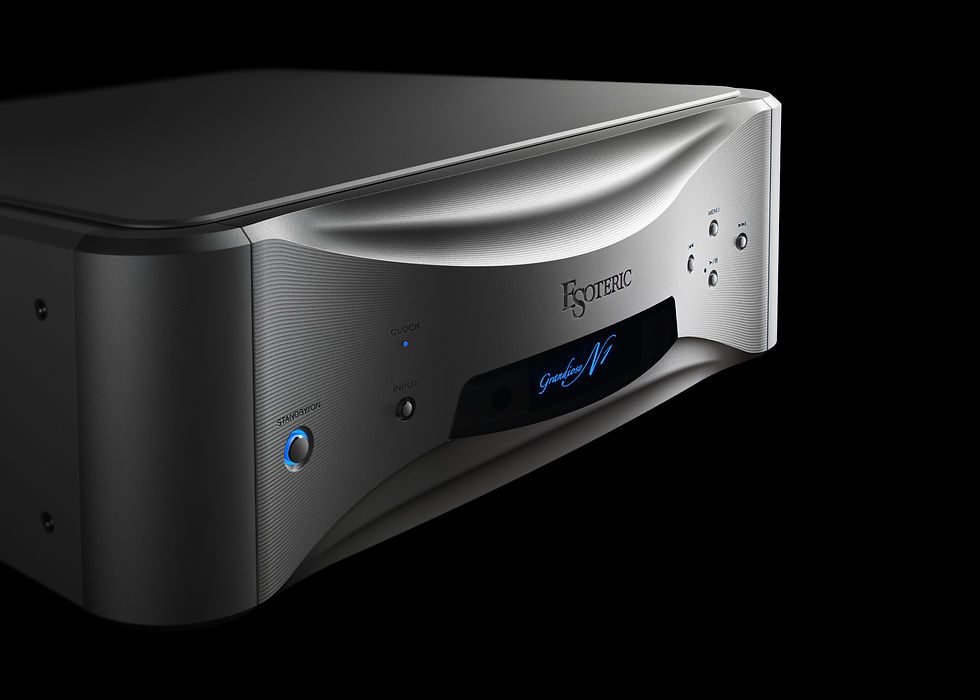
Esoteric Grandioso N1 Streamer/DAC
Greg Petan
10/10/26
.jpg)
Boxes, boxes!
Esoteric dates to 1987, when Japanese manufacturer TEAC expanded its reach into the high-end audio market. Like the market itself, Esoteric has seen its ups and downs over the years. However, few brands have managed to continuously maintain a reputation for exceptional sonics, rock-solid build quality, and museum-worthy aesthetic designs in the way that Esoteric has.
The N1 network streamer/digital-to-analog converter (DAC) ($45,000, all prices in USD) is the first integrated streamer/DAC within Esoteric’s flagship Grandioso line. Although the line has spawned several integrated components, it practically built its reputation by allocating key audio functions (e.g., DAC, transport, clock, and power supply for a CD player) across as many dedicated component boxes as possible. In fact, a full-blown Grandioso system, which contains a music server and a turntable, consists of no less than fifteen boxes. Holy rack space!


The goal: Separate-box architecture in a single box
Like all Grandioso components, the N1 is physically substantial. Its dimensions are 17 5/8" W × 6 1/2" H × 17 5/8" D, and it weighs a hefty 61 3/8 pounds. It is outfitted with a brushed-silver chassis and a gorgeous, sculpted CNC-machined faceplate that unmistakably says, 'We mean business.”
One of Esoteric’s goals with the N1 was to optimize its internal architecture for an integrated component. Indeed, its layout is a master class in electronic shielding, circuit organization, and vibration management. Central to that approach is a fully dual-mono configuration, with the left and right channels laid out separately. This arrangement is intended to improve performance by minimizing electromagnetic and radio-frequency interference (EMI and RFI, respectively) and crosstalk, while providing each channel with its own dedicated signal path and power supply.
Speaking of power supplies, the N1 contains five transformers. These serve, one each, the left and right channels, network engine, digital circuitry, and microcomputer circuitry. The latter circuitry covers such things as the front panel display, control commands from the front panel buttons, power-up sequences, mute relays, and system protection mechanisms.

But as Steve Jobs might well have said if he were discussing the N1’s power supplies, there is “one more thing.” The N1 can be connected to the optional Grandioso PS1 external power supply ($18,500). That component employs four additional independent transformers (two per channel) that power the analog D/A stage and buffer amplifier stages. When the PS1 is connected, the N1’s two transformers for the DAC’s analog circuit are relieved of those duties, thus furthering the electronic separation between the analog and digital power supplies.

Conversion
The heart of the N1’s DAC is Esoteric’s proprietary Master Sound Discrete DAC G2 (Generation 2) circuitry. Introduced to replace the company’s original Master Sound Discrete DAC, G2 employs Esoteric’s FPGA-based multi-level delta-sigma conversion architecture and fully discrete circuitry rather than a conventional off-the-shelf converter chip. Among the G2’s features are a redesigned resistor-switching flip-flop circuit, more extensively separated power-supply paths, and a dual-buffer output stage similar to that used in the Grandioso flagship D1X SE mono DAC ($58,000 per pair).
The N1 provides considerable flexibility in how digital signals are processed. For PCM playback, users can select no digital filter, an FIR filter with a slow roll-off and no pre-echo, or Esoteric’s proprietary RDOT filter. Separately, three PCM D/A conversion modes—M1, M2, and M3—alter the operating frequency of the delta-sigma modulator and its randomization algorithm, with M1 serving as Esoteric’s reference setting. PCM signals can also be converted to DSD before D/A conversion. For native DSD playback, users can select no digital filter or one of three filters—F1, F2, and F3—with progressively lower cutoff frequencies.

Timing is everything
The timing of the N1’s conversion function is handled by Esoteric’s Master Sound Discrete Clock for Digital Player, a proprietary discrete clock circuit developed for the Grandioso series. Rather than using an off-the-shelf oscillator module, Esoteric builds the Master Sound Discrete Clock with individually selected components, including what it states is a particularly large quartz crystal oscillator. This allows the company to control the clock circuit’s design, component selection, and power supply rather than relying on the fixed design of a third party.
Esoteric states that the timing accuracy of the N1’s conversion function can be increased by adding the optional Grandioso G1X Master Clock Generator ($32,000). For decades, Esoteric has championed master clock technology and worked continuously to advance it. I hope in the future to report back on both the PS1 power supply and G1X clock generator.

Music streaming
For network playback, the N1 employs Esoteric’s fourth-generation Network Engine, the G4, to receive, manage, and process network-based music data before it is sent to the DAC. The G4 features its own dedicated linear power supply, electrically separated from the audio circuitry. It also offers substantial processing power and memory capacity, which Esoteric says enable faster, more stable high-resolution music streaming. Interestingly, the G4 also incorporates a network switch, which is said to minimize the need for an external one. Its SFP port can accommodate either an optical connection—which provides electrical isolation from the upstream network—or a copper Direct Attach Cable.

The N1 supports Spotify, Qobuz, Qobuz Connect, TIDAL, and TIDAL Connect, and is also Roon Ready and JPLAY Certified. Network playback supports a broad range of file formats, including FLAC, ALAC, WAV, AIFF, MQA, DSF, DSDIFF, MP3, and AAC, with PCM resolution extending to 768kHz/32-bit and DSD to 22.5MHz (DSD512). In other words, there are very few high-resolution music files or network-playback scenarios that the N1 can’t handle.
The Esoteric Sound Stream mobile app provides all the basic control options for network operations, including music-library browsing, playlist creation, album-art display, and access to the supported streaming services.
The chassis and feet
The N1’s chassis uses thick aluminum side plates and a 5mm-thick steel base plate for rigidity and resonance control, while its top and bottom layered structure physically separates key circuit sections. A semi-floating top panel and Esoteric’s proprietary isolation feet are said to further contribute to vibration management. Even the feet are unusually elaborate, reflecting considerably more engineering than is typical of those found beneath most high-end audio components.

A walk around the N1
The N1’s front panel is surprisingly minimalist for a component of its design complexity. A large display provides information such as the selected input, playback format, and sampling rate, while a blue-ringed standby/on button and clock-status indicator sit to the left. To the right are dedicated controls for input selection, menu access, and basic playback/navigation functions, allowing operation without disturbing the clean Grandioso aesthetic. More extensive control of network playback and music libraries is handled through the Sound Stream app.
The rear panel is considerably busier than the front, with a broad array of digital, network, clock, and analog connections. Digital inputs include the proprietary ES-LINK5, XLR, coaxial RCA, optical, and USB Type-B, while Ethernet and an SFP connection (which supports fiber optic transfer) provide wired network connections. ES-LINK5 is Esoteric’s ultra-wideband digital transmission interface that uses two HDMI cables to carry signal data between compatible Esoteric digital components such as a transport and DAC.
A 10MHz BNC clock input, 3.5mm trigger input, and two storage drive USB ports (one Type-A and one Type-C) further expand system flexibility, while RCA and XLR/ES-Link Analog outputs handle connection to a preamplifier or integrated amplifier. ES-Link Analog is Esoteric’s proprietary current-transmission analog connection between the company’s compatible source components, preamplifiers, and amplifiers. It uses a standard XLR cable, but the electrical transmission method is proprietary. Also present are an IEC AC inlet, signal-ground terminal, two DC inputs for the optional Grandioso PS1 external power supply, and a service/update port.


Do not scratch. Do not scratch!
The finish on the N1 is gorgeous but delicate, and it can be easily scratched. Bearing this in mind as well as its considerable size and weight, I carefully placed the review sample into my component rack. I connected the N1 to a Vitus SIA-030 integrated amplifier ($57,750) via the N1’s RCA analog outputs. Speakers and cables were from Estelon (XDiamond MkII SE/$144,900) and WAY Cables, respectively. A network connection was made via Ethernet from my mesh router.
One thing I omitted above: the N1 does not come with a remote control. It is primarily operated through its front-panel controls and the Sound Stream app, though certain basic N1 features can sometimes be controlled by remotes from other Esoteric products.
I am not a big fan of digital filters. I find the choices offered for any given DAC often result in insignificant sonic differences that give me a headache when trying to choose one. For my listening, I chose to bypass both the PCM and DSD digital filters, and I used the M1 PCM reference conversion mode.
The Sound Stream app operated intuitively and seamlessly, which is all I need. I primarily used it to stream music through Spotify Lossless. I found that it neither added to nor subtracted from the original streaming source as some music control and discovery apps can.
Finally, I let the N1 run in for about 250 hours before I began my audition. But as surely as some pseudo-audiophile will claim that it’s all in my head, the sound continued to improve for quite some time.
The rubber meets the digital road
At the risk of dating myself, my reviews of digital audio components harken back to the days of Wadia, Proceed, and Meridian, along with Krell’s earliest efforts. At the time, manufacturers were still trying to bridge the divide between the old analog guard and the upstart “Perfect Sound Forever” crowd. Fast forward to today, and the progress made by engineers—as exemplified by the N1—has taken digital audio to places that I could only have dreamed of back then.
I started with some great rock and roll, although the recordings varied in sound quality. The N1 made my system’s presentation of “Lonely Stranger,” from Eric Clapton’s Unplugged (Reprise/44.1 Spotify), surprisingly lifelike. Clapton’s voice and guitar, along with the band and backing vocals, were clearly layered from front to back across the soundstage. During the performance, Clapton moved among three guitars, and I could discern the individual locations of each onstage. As I put more time on the player, instrumental colors grew richer, midrange bloom became more pronounced, and images snapped more firmly into place.

“Show Your Love,” from Van Halen’s self-titled debut album, Van Halen (Warner Bros./44.1 Spotify), exploded from the speakers in a frenzy of energy without becoming disorganized or congested. On “D.O.A.,” from Van Halen II (Warner Bros./44.1 Spotify), the detail of the plate reverb surrounding David Lee Roth’s voice not only remained intact despite the surrounding sonic mayhem but was even more distinct than I had heard before. What I discovered was that prior to listening through the N1, the distortion on this track was itself distorted, thus masking its detail!


If there was one area where early digital audio fell short less obviously than in its screechy treble and poor tonal accuracy, it was the mid- and deep bass. Back then, “we”—if I may speak in the royal sense—initially fell hard for digital’s tighter, faster midbass compared with analog’s fuller, more generous bloom. Before long, however, it became apparent that something was missing: the mid- and lower bass lacked some of the texture, complexity, and natural shading we were accustomed to hearing from analog.
The N1 proved that this shortcoming in digital music reproduction is no longer a “thing.” Geddy Lee’s bass guitar on “Limelight,” from Rush’s 1981 masterpiece Moving Pictures (Mercury/44.1 Spotify), was clearly being driven through a low-frequency distortion effect, which the N1 presented with far more texture than I had ever imagined was there. The midbass punch remained largely intact, but the added complexity I was now hearing made the music more interesting. Moving back to Van Halen II, I heard much of the same thing. Michael Anthony’s bass, which can often sound hopelessly buried in the mix, came through with much greater definition.

Now on to some of the best-recorded music on my playlists. Eva Cassidy surely meant business on Live at Blues Alley (Didgeridoo Records/44.1 Spotify). “Stormy Monday” is captured brilliantly on the recording, and Cassidy’s band maintains the restraint necessary to showcase her sultry, expressive vocals. With the N1, the sound was focused and super-clean, providing a sense of the song unfolding in real time and space. Dynamics were unfettered, making it simple to just listen and let the music wash over me.

I’ve been listening to the Keith Jarrett’s Trio’s Standards Live (ECM/44.1 Spotify) for what feels like forever, and it has graced nearly every system and component I’ve reviewed. Through the N1, the piano was especially convincing, with exceptional clarity in the initial percussive attack and a natural sense of bloom as each note developed. Even when Jarrett ventured into the shrillest of high registers—not a place he spends much time—the notes seemed to shoot into space without losing the organic character of everything below. It simply sounded like a real piano.
The N1 also rendered Jack DeJohnette’s drums on Standards Live with remarkable presence, filling the air around each strike with shimmering textures and detail while preserving dynamics that rose and fell with utter believability. Gary Peacock’s exploration of counter-harmonies came through with both subtlety and assured rhythmic control. Man, I love this guy’s playing.

And in the end
No caveats are required in making a strong case for the Esoteric Grandioso N1 Network Streamer/DAC. Its ability to strip away digital harshness and distortion was almost jarring. Most surprising to me was that artifacts that I had long assumed to be inherent to the recording were instead revealed to be failings of the playback gear. Listeners unaccustomed to this level of glare-free sound may initially label it as lean, but nothing could be further from the truth. What the N1 removes is not body or richness but the electronic haze that can masquerade as warmth and weight.
And if that was not enough, the N1’s strengths extend well beyond sonics. It combines exceptional build quality, extensive features and functionality, and museum-quality aesthetics in a single component. It is expensive, but I don’t know of a less costly integrated DAC/streamer that plays at this level.
The N1 changed the way I think about digital playback. For me, there is no going back. I am buying the review sample and, going forward, expect music streaming to play a much larger role in my listening.

Esoteric Grandioso N1 Network Streamer/DAC
Price: $45,000
Warranty: Three years parts and labor; can be extended to five years with US market registration
Esoteric
Tama, Tokyo, Japan
Associated Equipment:
● Loudspeakers: Estelon XDiamond MkII SE
● Integrated amplifier: Vitus SIA-030
● Power conditioner: Triangle Art RA ultimate
● Power cables: WAY Cable Poetry X
● Interconnect and speaker cables: WAY Cable Poetry X XLR IC, Poetry X bi-wire1X master clock